
Milan Gudeljević reflects on how years of experimenting with immersive technology are leading toward a new generation of location-based travel experiences.
For more than a decade, the travel industry has been experimenting with ways to connect the digital and physical worlds.
Virtual reality allowed people to experience destinations before visiting them. Augmented reality placed digital content directly into real environments. Mobile apps replaced printed maps and traditional audio devices. Today, artificial intelligence can build an entire travel itinerary in seconds.
But perhaps the most interesting evolution is not happening before the trip.
It is happening while the traveler is already there.
At VR Pole, we have been exploring this intersection between technology, storytelling and physical locations for years. From early augmented and extended reality tourism experiences to today’s mobile, GPS-based formats, one thing has remained consistent.
For Milan Gudeljević, one of the people behind VR Pole’s development of digital tourism experiences, that evolution has always been less about introducing technology for technology’s sake and more about finding better ways to connect people with real places.
“Technology works best when it adds context to the real world instead of trying to replace it.”
That principle remains at the center of how we look at the next generation of travel technology.

From Virtual Experiences to Location-Based Experiences
When VR and AR first became widely accessible, tourism was one of their most obvious applications.
A visitor could point a device toward a historical location and see how it once looked. A museum could reconstruct an object digitally. A tourism board could allow people to experience a destination virtually before arriving.
Our own work with location-based XR experiences followed the same idea: digital technology could reveal layers of a place that were otherwise invisible.
That principle remains relevant today.
What has changed is the technology required to achieve it.
Travelers no longer necessarily need specialized headsets, dedicated equipment or complex applications to experience digital storytelling.
They already carry an extremely capable device in their pocket.
The smartphone has become the interface.
The Smartphone Is Becoming a Personal Travel Layer
Modern smartphones already understand where we are.
They provide navigation, camera access, video, translation, recommendations, payments and communication.
The next logical step is combining these capabilities into experiences that respond to the traveler’s physical surroundings.
Instead of searching for information about a location after arriving there, content can be designed specifically for that moment.
A traveler reaches a square.
GPS identifies the location.
A short video explains what happened there.
A local storyteller points out something that would otherwise go unnoticed.
Then the traveler continues whenever they want.
This creates a fundamentally different relationship between technology and destination.
The phone is no longer simply helping us find a place.
It is helping us understand the place once we arrive.
Why Video Changes the Traditional Self-Guided Tour
For years, self-guided tourism was primarily associated with maps and audio guides.
Both remain useful formats.
But video introduces another layer.
A presenter can point toward a detail on a building, show an archival photograph, demonstrate how something worked or simply communicate personality through facial expression and body language.
That matters because tourism is not only about information.
It is also about storytelling.
A factual description can explain when a building was constructed.
A good storyteller can explain why somebody living in that city actually cares about it.
That distinction becomes increasingly important as artificial intelligence makes basic travel information almost universally available.

AI Can Provide Information. Human Storytellers Provide Perspective.
Artificial intelligence is rapidly changing travel planning.
Travelers can already ask increasingly specific questions:
What should I do in Zagreb if I only have three hours?
Create a walking route through Amsterdam that avoids the busiest attractions.
Where should I eat near my hotel?
AI will become exceptionally good at answering questions like these.
But the abundance of automatically generated information may actually increase the value of authentic human perspective.
A local guide can tell you the unusual story behind a street.
A resident can explain something that tourists usually misunderstand.
A creator can communicate the atmosphere of a neighborhood in a way that a database cannot.
The interesting future is therefore probably not AI versus humans.
It is AI helping people discover the right experiences, while humans provide the stories that make those experiences memorable.
From Augmented Reality to GPS Video Tours
This is where we see an interesting evolution of earlier AR and XR concepts.
The fundamental idea has not changed:
Digital content becomes more valuable when it is connected to a physical location.
What has changed is the level of friction.
An augmented reality experience may require a specific device interaction, camera positioning or visual recognition.
A GPS-based experience can be extremely simple.
Walk to a location.
Open the content.
Watch.
Continue exploring.
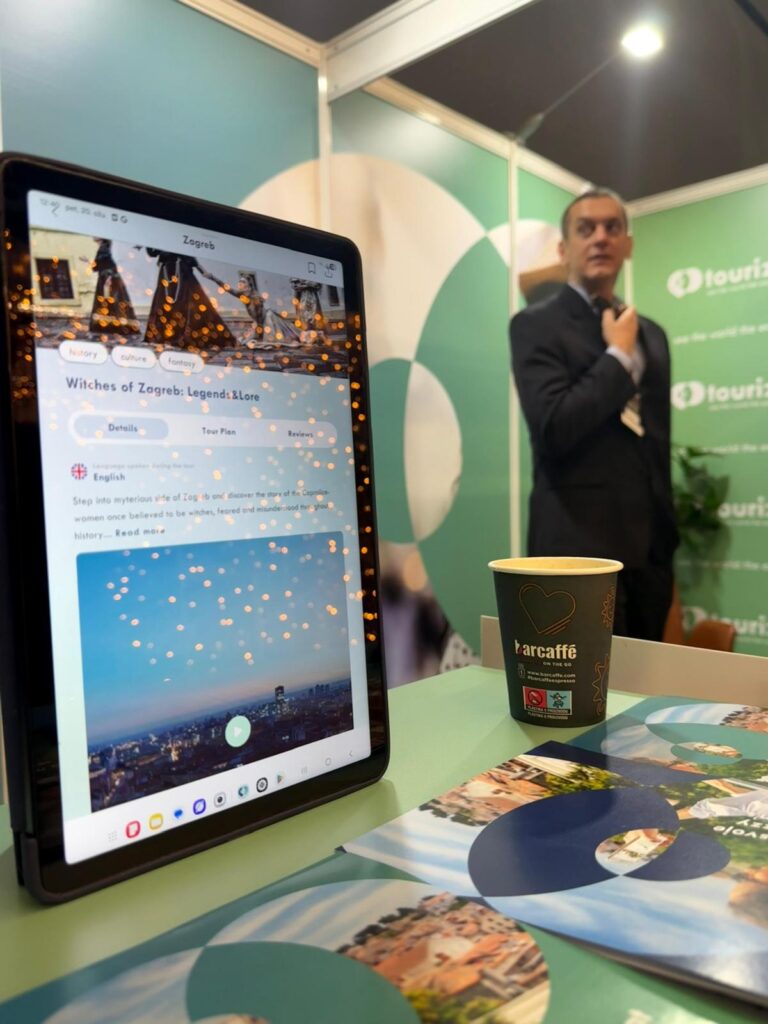
One example of this direction is Tourizzy, a GPS-guided video walking tour platform where travelers discover cities through short, location-based videos created by real local guides and storytellers.
From a technology perspective, the concept is considerably simpler than many immersive XR experiences.
From a user-experience perspective, that simplicity may be precisely its advantage.
The traveler does not need to learn the technology.
The technology simply supports the journey.
The Next Innovation May Actually Be Less Technology
This might sound contradictory coming from a company with VR in its name.
But after years of working with immersive technologies, one lesson has become increasingly clear:
More technology does not automatically create a better experience.
As Milan Gudeljević explains, this is also one of the biggest lessons from years of experimenting with immersive and interactive technologies:
“In the early days, we were often asking what technology we could add to an experience. Today, I think the more important question is what technology we can remove while still making the experience better.”
A traveler does not necessarily care whether an experience uses augmented reality, artificial intelligence, computer vision or a sophisticated recommendation engine.
They care whether it helps them enjoy the destination.
That changes how travel technology should be designed.
Instead of asking:
What new technology can we add?
Perhaps the better question is:
What friction can technology remove?
The most advanced solution may ultimately be the one that becomes almost invisible.
Travelers Increasingly Want Flexibility
Traditional guided experiences usually operate according to schedules.
That is often perfectly acceptable and, for many travelers, still the best way to discover a destination.
But mobile technology enables another behavior: spontaneous exploration.
A traveler can start at 10:15 or 17:40.
They can stop for coffee.
They can skip one location.
They can spend an hour somewhere unexpectedly interesting.
They can continue tomorrow.
That flexibility is becoming an increasingly important characteristic of digital travel experiences.
It does not mean traditional tours disappear.
It means travelers gain another option.
The same thing has happened throughout the broader digital economy: technology does not necessarily eliminate existing formats. It creates new ones alongside them.
Location Is Becoming Part of the Content
For us, one of the most interesting concepts in the next generation of travel technology is location-aware content.
Traditional content exists independently of where somebody consumes it.
A video about Dubrovnik is essentially the same whether you watch it from Croatia, New York or Tokyo.
Location-based content changes that relationship.
The content can have its greatest value when consumed at the exact place it describes.
That creates interesting possibilities far beyond conventional sightseeing.
Hotels can provide neighborhood experiences to their guests.
Museums can extend interpretation beyond their physical buildings.
Tourism organizations can create distributed digital experiences throughout a destination.
Cultural institutions can connect stories to physical locations.
Local creators can transform their knowledge into reusable travel experiences.
In that sense, the city itself becomes the interface.
CEO of travel tech app Tourizzy
Hotels Could Become Digital Gateways to a Destination
Accommodation is another area where location-based technology has significant potential.
A hotel knows exactly when the traveler has arrived at the destination.
Yet once the guest leaves reception, the hotel often becomes disconnected from the rest of the travel experience.
Guests still ask familiar questions:
What should we see this afternoon?
Where should we walk?
What is worth seeing nearby?
Traditionally, the answer might be a printed map, a verbal recommendation or a list of attractions.
Digital travel experiences make it possible to go further.
A QR code in a hotel room could open a neighborhood experience.
A hotel website could provide access to a self-guided city tour.
A traveler could immediately access stories about the destination without needing to book a specific departure time.
The hotel does not necessarily need to become a tour operator.
It can simply become a better interface between the guest and the destination.
What Comes After GPS Video?
GPS video tours are unlikely to be the final form of this evolution.
We expect several technologies to increasingly converge.
AI can personalize recommendations.
GPS provides context.
Computer vision can recognize the environment.
AR can visualize information.
Video provides human storytelling.
Real-time translation removes language barriers.
The interesting product opportunities will come from combining these technologies without overwhelming the traveler.
A future city experience might understand that you have two hours available, know what you are interested in, recognize where you are and automatically surface a short story from a relevant local expert.
The technology behind that experience could be extremely sophisticated.
The interaction itself should feel simple.
Travel Tech Is Becoming Experience Tech
For a long time, travel technology focused primarily on helping people reach a destination.
Booking platforms helped travelers find flights.
Hotel platforms helped them find accommodation.
Maps helped them navigate.
Review platforms helped them choose where to eat.
AI is now making travel planning faster and increasingly personalized.
The next major opportunity may be what happens after all of those decisions have already been made.
What happens when the traveler walks out of the hotel?
What happens when they reach a monument?
What happens when they enter a neighborhood they know nothing about?
This is where travel technology begins becoming experience technology.
And for Milan Gudeljević, the progression from VR and augmented reality toward simpler mobile and GPS-based experiences is not a rejection of immersive technology.
It is an evolution of the same idea.
The goal was never simply to put more technology between travelers and the world around them.
The goal was to help them understand that world better.

Technology Should Lead Us Back to the Real World
Perhaps the most important lesson from the evolution of travel technology is that the destination must remain the main experience.
VR can transport us somewhere else.
AR can add another layer to reality.
AI can organize enormous amounts of information.
GPS can understand where we are.
Video can bring a local storyteller directly to the traveler.
But ultimately, people travel because they want to experience the real world.
The streets.
The architecture.
The food.
The history.
And, perhaps most importantly, the people.
The next generation of travel technology will succeed not because it makes travelers look at their screens more.
It will succeed if it uses those screens intelligently enough to make travelers look at the world around them differently.
As Milan Gudeljević puts it:
“The best travel technology shouldn’t become the experience. It should help you experience the destination better.”
And perhaps that is the most interesting transition of all — from virtual reality, augmented reality and immersive technology toward digital tools that ultimately encourage us to spend more time experiencing the real world.
About the Author
Milan Gudeljević is an entrepreneur working across digital experiences, creative technology and travel tech. Through projects developed within VR Pole and later initiatives such as Tourizzy, his work has explored how immersive, mobile and location-based technologies can connect digital storytelling with real-world places.